Days on Market and How it Affects Your Return
Date: 7 May 2026
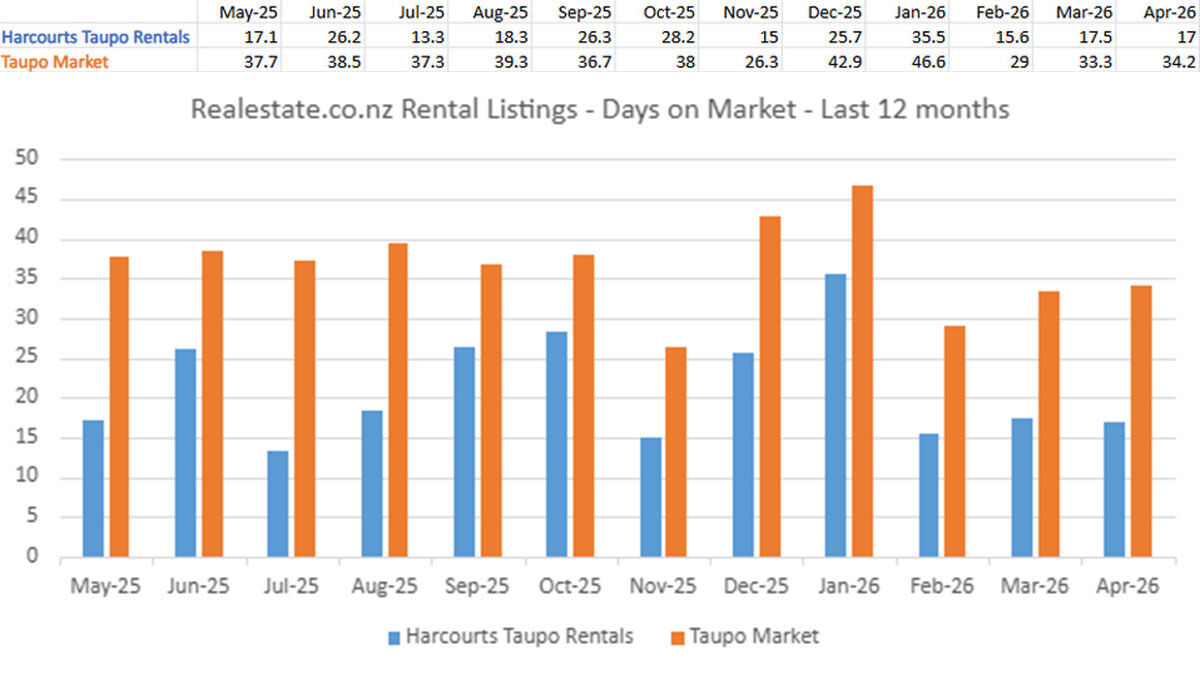
Data from realestate.co.nz shows that on average we rented our clients properties 2 weeks faster than the Taupo market over the past 12 months. For three of the past 12 months, we were 3 weeks faster. On our slowest month we were still 9.8 days faster than the market.
How is this being achieved?
It could be that:
- Landlords are bringing properties to us that tenants actually want,
- We are more efficient and use better processes and strict actionable timeframes consistently,
- The properties are priced to meet current supply and demand dynamics,
- We have better advert copy, better photos and better communication,
- Tenants want to rent through Harcourts.
However it is being achieved, the fact is - it is. We consistently rent properties faster than the market.
So, on to the point of this and how it affects your return. Let’s look at a couple of examples from the data using the suspicion that vacancy is due to asking price.
Starting with March 26 where our average days on market was 17.5 and the rest of the market was 33.3 days. The extra days on market was 15.8 days. In this example we will say that our client’s property is priced at $650 and the market client’s property is priced at $680.
Our client lost $1,625 in rental income due to vacancy. The market client lost twice that at $3,230 and even worse is stuck with paying all holding costs for two and a quarter additional weeks. Ouch.
During a 12 month period, our client earns $650 for 49.5 weeks. The market client eventually (well maybe as we don’t actually know if the advertised price was the achieved price) earns $680 week for 47.3 weeks.
When you do the math, you will see that both clients earn the same annual rental income.
But our client potentially has:
- a happier tenant
- a better tenant
- a tenant that will stay longer
- lower long term vacancy
- the ability to increase the rent in 12 months time
Where the days on market margin increases, for example in August where we sat at 18.3 days and the market 46% slower at 38.3 days, our client earns $650 for 49.4 weeks, the market client earns $680 for 46.4 weeks. Our client earned $558 more than the other guy because our client avoided extended vacancy. And our client has a better chance of enjoying the other benefits mentioned above in 12 months’ time and beyond.
If we do the calculations where the asking prices are the same at $650 – so perhaps the vacancy isn’t due to price but due to inefficiencies, in the March example our client is $1,430 better off annually and in the August example, our client is $1,950 better off.
It is critical to understand the cashflow and profit pressures of vacancy, use efficient processes to get your property rented and understand that a higher rent rate doesn’t always mean higher income. Use our simple income and vacancy calculator to run the numbers. tauporentals.co.nz/income-and-vacancy-calculator
Back...